


Of all the life lessons and pieces of advice my mother blessed me with during my formative years, there were three in particular I heard more than any of the others. I think each of them were passed to her at a similar age by my grandfather, and were sometimes prefaced by the phrase “My father always said…” Each time she reiterated one of them, between her words, I could always sense her deep love for my grandfather, and in passing them down, her immense love for me. They were genuine strategies on how to live a good life, and as I grew older I realized how truly typical, yet immensely important, they all were.
The first tenet is as simple as the other two: “Always tell the truth.” I’m sure it’s what led me to exclaim, “I don’t like her, take her back,” when my mother and father brought my sister home from the hospital for the first time. (For the record, I love my sister dearly.) I’m sure it comes as no shock that as a toddler the advice was sometimes painfully easy follow. Yet, as I got older things grew a bit more complicated. By the time I was old enough to hear my mother’s exasperated yell from the kitchen asking, “Who didn’t make more Kool-Aid?” − even if I was the one who had left just enough cherry red liquid to cover the bottom of our cornflower blue pitcher − I’d instead engage my sister in one of our favorite pastimes; a cutthroat game of No I Didn’t, You Did! Now I know it must be deeply surprising to learn that I didn’t always follow my mother’s heartfelt advice, but sometimes it was just more fun to watch my innocent sister forced to prepare a new batch of the faux-fruit delight. But as I matured I appreciated the deeper meaning of what my mother was trying to teach me − the importance of being a decent human being – and as an adult I’ve always held her advice very close to my heart.
This, quite appropriately, brings me to her second rule: “If you don’t have something nice to say, don’t say anything at all.” On the surface it’s seems like a simple piece of advice, right? Spare people’s feelings as often as you can. But I was never a simple kid. My brain likes to complicate things. From around the age of five I realized that the first rule didn’t always align with the second, and sometimes they downright contradicted each other. If my mother’s dress had such pronounced shoulder pads (it was the 1980s after all) that it made her look like five foot two inch tall linebacker, what was I supposed to say when she asked me if I liked her new outfit? On the day my stepfather shaved his beard, which he’d had since the day I met him years earlier, was I supposed to tell him that his suddenly naked baby-smooth face frightened me a bit, or go conspicuously silent when asked how he looked? If the truth wasn’t nice, which rule took priority?
My mother’s third oft-repeated tenet, “You can count the number of your true friends on one hand,” may almost seem incongruous to my thesis by this point (besides the fact, as applied to the overly friendly and trusting boy I was in those days, it was the most helpful), yet my reason for including it is just as important. If I hadn’t learned how to bring the first rule into some kind of harmony with the second I am a stone’s throw from certain that today I would be a very lonely man, one with a lot of internet fueled theories and for some inexplicable reason even more pet birds, not the reasonably well-adjusted intellectual middleweight that is blessed with the ability to count his number of true friends on at least both hands.
Yet it wasn’t until college that I really started to understand how to square the purest intent of my mother’s first two rules. Before then, if someone asked me a pointed question whose answer might have elicited an awkward pause or a barefaced lie, I simply would’ve sidestepped the query. I did so with such gusto that I’m sure anyone watching would have said that I obtained my dance training from Patrick Swayze. But by college I started to realize there was a better way. I started to grasp that when one of your closest friends asks you if you like their newly dyed head of unnaturally shiny cobalt-blue hair, you face the question head on, and with a bright smile you augment the truth. “I couldn’t pull it off, but it suits you.” What you don’t do is stutter your way into silence, or tell them that they suddenly look like a demented emo Troll doll. But if that same friend asks you what they should do when they find themselves close to failing out of school after getting their heart broken, the Laws of Friendship dictate that you are required to tell them to get their head out of their ass and their act together.
Surprisingly, it took me a few more years to really understand the deeper nuance of this harmony. At the time I was working tech support in a call-center for a big northeastern bank, and across from me sat a man named Pat. He was a stout fellow close to twice my age, with a balding head of graying reddish hair. He was also, in a lot of ways, a walking contradiction. Pat could sometimes be hilariously crass, but other times he came across as Eeyore’s emotional twin. It couldn’t have been more apparent each Monday morning when our workweek would begin with the same innocuous question: “How was your weekend?” Sometimes Pat would answer with jubilant positivity: “Oh, it was great. Went to the beach with my girlfriend. These annoying little shits in the spot next to us were playing Frisbee and kept kicking sand on us. So when they weren’t looking I buried their Frisbee.” Pat took great pleasure in things like this, and would let out a boisterous laugh that mixed unpleasantly with his crunchy exhale, the result of years of smoking. Then he’d exclaim something like, “Little shits cried,” with absolute satisfaction, along with another wince-inducing laugh. Other weeks, though, Pat’s response was much different. From the moment he opened his mouth I could sense seething anger broiling just below the surface. “Tried to go to the movies Friday night,” he’d say in a low rumble, before unleashing everything he was feeling in a spectacular explosion. “They’ve been working on Washington Avenue Extension for what, two years? You think they’d have finished by now. Or they would’ve planned better and not be working on roads by the damn mall on a Friday night!” Then after a breath, Pat would downheartedly add, “By the time we got there the movie was sold out. Just. My. Luck. Why am always the one who has to deal with these goddamn idiots?” It was conversations like this that helped me to understand what I had been practicing for a couple of years by then.
In my clumsy twenty-something way I tried to help Pat see the broader reality of the situations in which he found himself − that the Albany County Department of Public Works was not out to ruin his Friday night, or that the cashier at the grocery store he frequented was not slowing down on purpose every time he got in her line, but Pat saw things differently. In return, he helped me to realize that not all truth is absolute – not when it comes to one’s own perspective or opinion – and that there is immense power in personal truth. It is the reason why my mother’s first and second rule can coexist. To me her padded dress made her look conspicuously like Dick Butkus, but that was my truth – likely hurtful and not something that should be readily disclosed. If the dress might cause her to suffer judgment or ridicule I’d have an obligation to speak up, but in her case, and in the case of my friend with the cobalt blue Troll-cut, for all I knew they looked totally radical or so fly to everyone else polled. In the years since, this has held true for almost everyone in my life, save for my brothers, cousins, and a few of my closest friends. In their cases I am always more than happy to tell them bluntly, “Um… No. No way! You can’t pull that off.”
I know. Sometimes love is weird.
In the interest of full disclosure, there’s another facet of Pat’s personality that I should probably mention. The fact that I had to endure it makes our interactions even more ironic, and elevates Pat’s enigmatic status in my life. For the entirety of the near eighteen months that I worked across from him, whenever I’d complain about anything – our job, the state of the world, the fact that the air conditioning vent above my desk emitted a foul odor that made me feel sick – Pat would always respond the same way: “Would you like a little whine with that cheese?” To this day it really pisses me off. Who was he to disregard my angst in such an off-handed manner? To be honest, I think it may be the reason I am extra-sensitive to the unintended consequences of personal truth. It’s why, whenever I critique anything, whether it be a movie, a book, or some other form of individual or creative expression, I always like to preface my statements with the words, “I think,” or “To me.” As in, “I think this almost seventeen hundred word preface has gone on long enough.” Or “To me, all of this seemingly useless information will makes sense later.” Well, at least that’s my hope. But if not, please keep my mother’s second rule in mind.
________________

After a relaxing evening puttering around my room at the Good Nite Inn, the next morning began the third wine county adventure of my trip. It also marked the beginning of its second week. I could see indications of a recent downpour as I walked to my car – dark patches on the blacktop, and quickly vanishing droplets of water on my car windows − but it looked as if the sun was determined to peek through the clouds. It was a good thing too, because I had a big day ahead of me.
As I got on the road I was determined not to think about the plans my former fiancée and I once made for the occasion. After arriving in Rohnert Park the night before I had, for the most part, been able to keep the promise I’d made to myself, but as the day began it got decidedly harder. Still, I was resolute. Nothing was going to get in the way of my adventure, or some nice wine, even if my first stop of the day had nothing to do with wine tasting. My friend Pat – a much kinder and gentler fellow than the Pat previously mentioned – had very generously gifted me a couple of tickets to the Charles M. Shultz Museum and Research Center when he learned my trip would take me nearby, and it seemed like the perfect place to start the day.
Pat is a huge fan of Peanuts – a fact evidenced in the collectibles that no matter where he is always float somewhere in his general orbit, occasionally bumped by a not-so-invisible force to the center of conversation. He is always reminding me that their name doesn’t include the definite article – so it’s not The Peanuts, as I seem eternally intent on calling them. Pat’s knowledge of Peanuts is vast, and his immense love frequently brings him to the museum, located in the small Northern California town of Santa Rosa where Charles M. Shultz spent most of his life. I, on the other hand, enjoyed the comic strips and animated television specials growing up, but never really gave much thought to the man behind the wonderfully entertaining work.
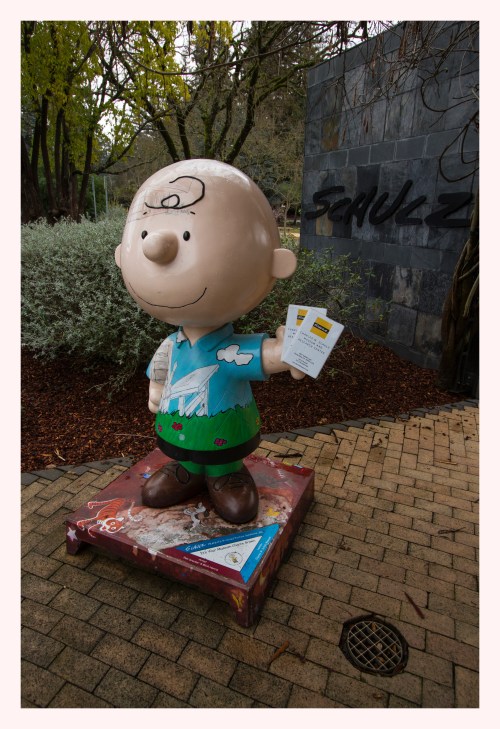
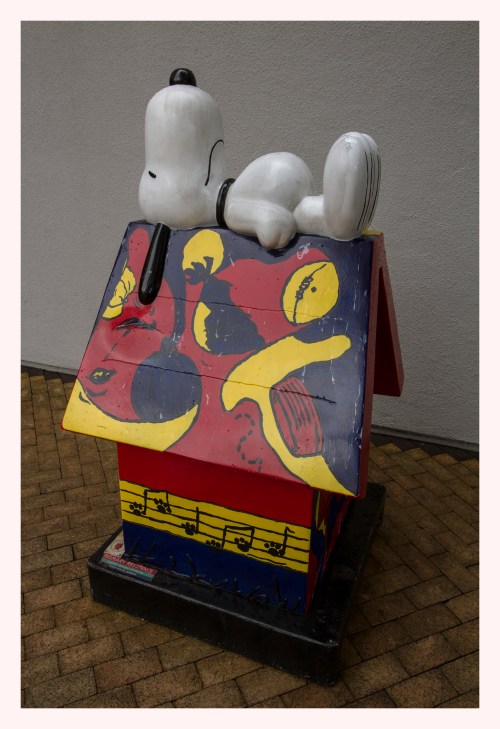
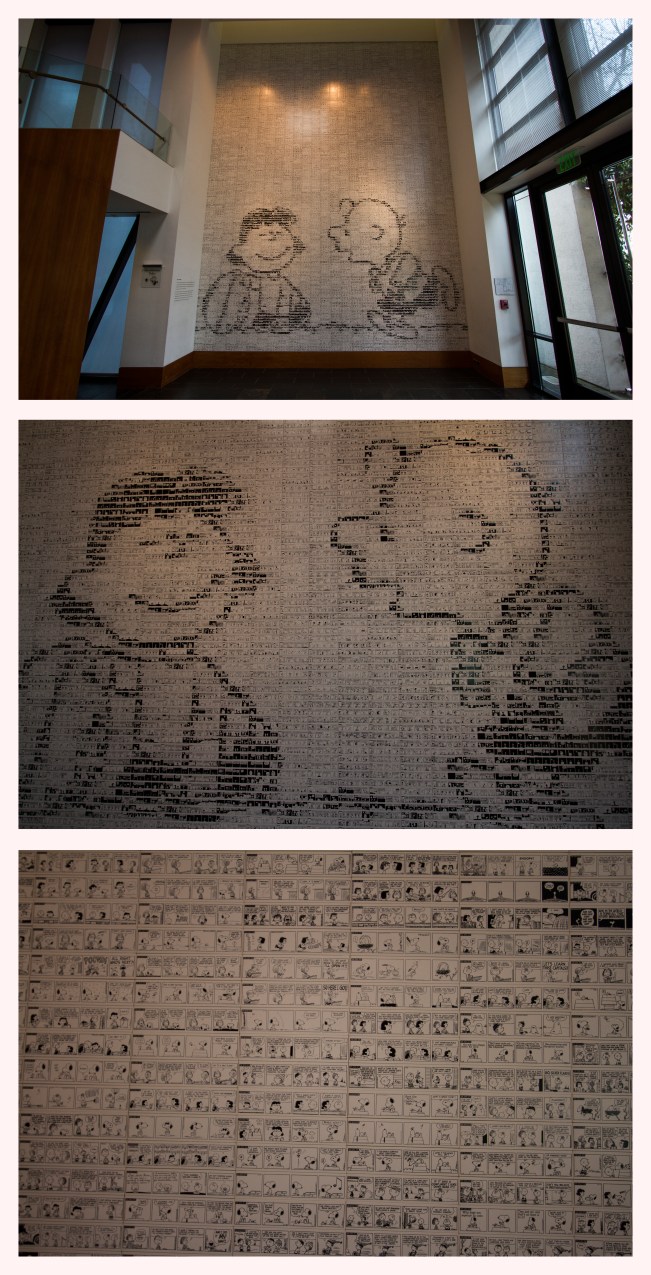
Not surprisingly, Charles M. Shultz was always fond of drawing. During his youth in Saint Paul, Minnesota, he had varying degrees of success with his art, but after serving in World War II he became determined to make it a career. Shultz took odd jobs in the field − grading student’s work for a home study correspondence school in cartooning and illustration as well as lettering for a faith-based comic magazine − while at the same time trying to find a way to make his mark in the world of comics. Over fifty years later, by the end of his career, he had become arguably the most influential comic strip artist who’s ever lived. Though, as I made my way through the museum that honored him, it wasn’t the work − as remarkable as it was – but rather the man that impressed me the most.
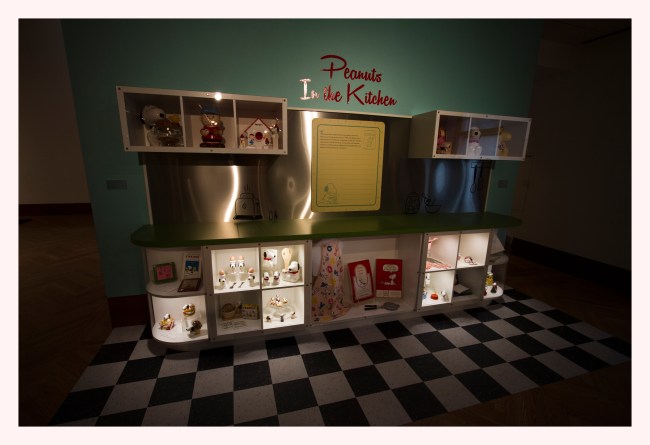
At every turn I took through the museum’s many rooms, I got vivid impressions of Charles M. Shultz’s strong character – his faith, his sense of social responsibility, and his immense kindness. To me, maintaining these values, while at the same time reaching the highest of heights in one’s field, is the greatest measure of a person, and Charles M. Schultz was the epitome of that.
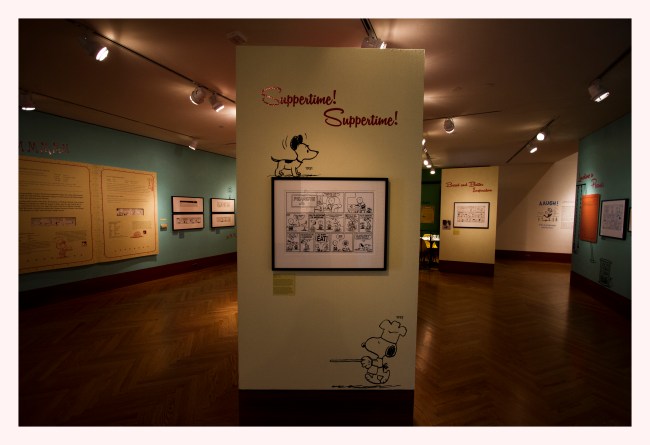


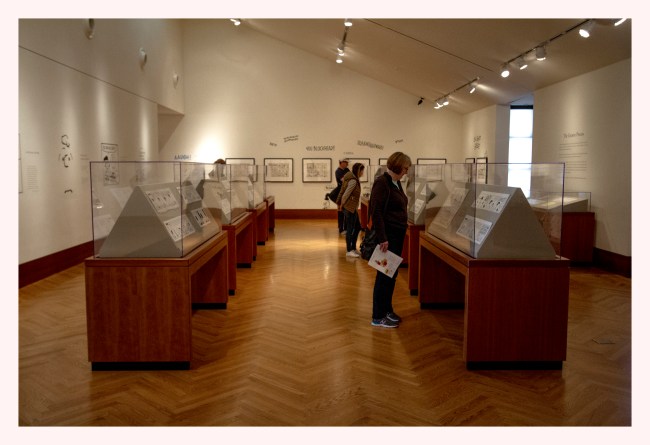
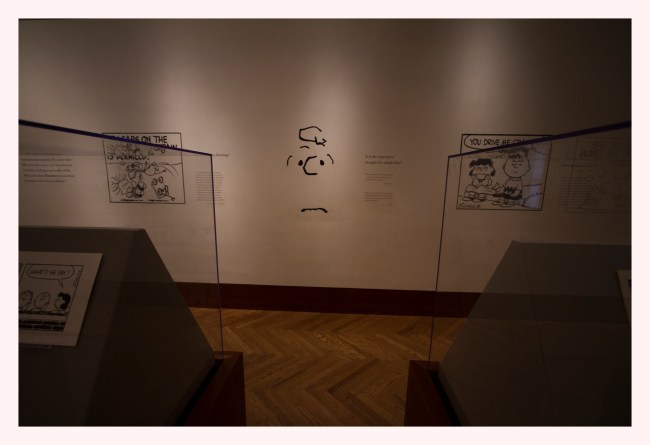

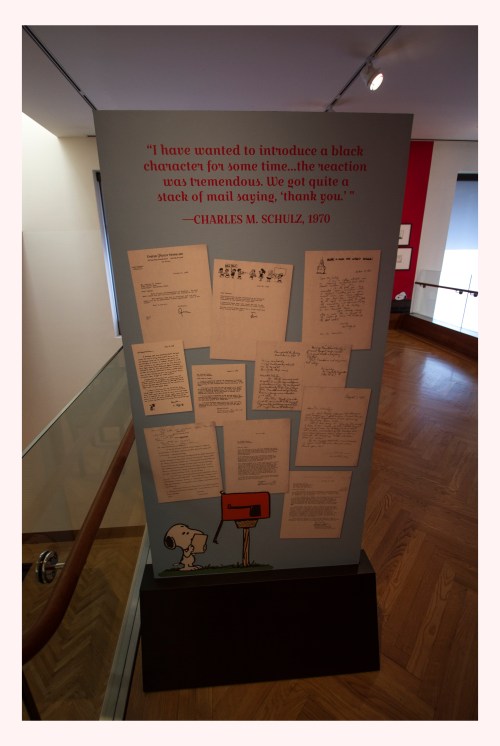
Take for example Franklin, the first African American Peanuts character. During my visit the museum was celebrating the 50thanniversary of his creation with a temporary installation, and it afforded me the opportunity to learn all about Franklin’s birth. Schultz introduced the character in 1968 shortly after the assassination of Rev. Dr. Martin Luther King, Jr. at the suggestion of a Los Angeles schoolteacher named Harriet Glickman. In his first strip, there was no pointed reference to Franklin’s skin color, no allusion to the importance of the moment. On a typical day at the beach Franklin happens to find Charlie Brown’s beach ball floating in the water, and returns it to him. The two strike up a conversation, and end up building a sandcastle together. At a time when racial tensions in the United States were extremely high, it depicted a simple interaction between two children, yet the reaction to it was instantaneous − both good and bad. On one hand scores of readers, who for the first time could see themselves in a Peanuts character, were deeply moved and inspired by the representation. On the other, there was backlash. One of Charles Shultz’s own editors even commented that he was fine with a black character, but not that Franklin was depicted in school with white students. To this Schultz told the man, “Either you print it just the way I draw it or I quit. How’s that?”
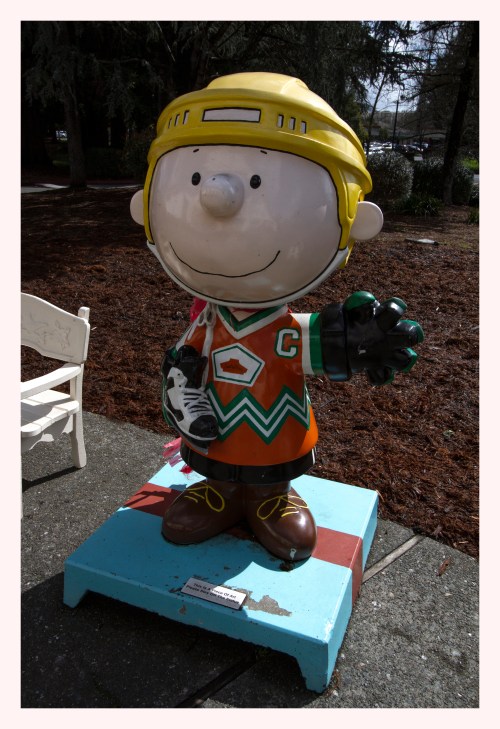
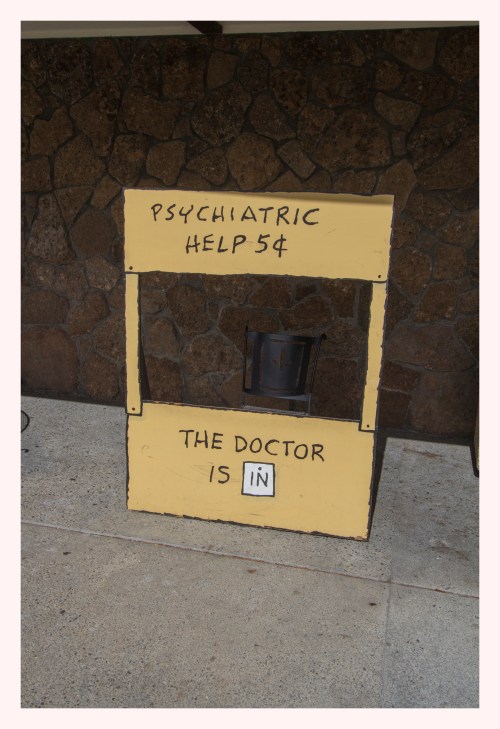
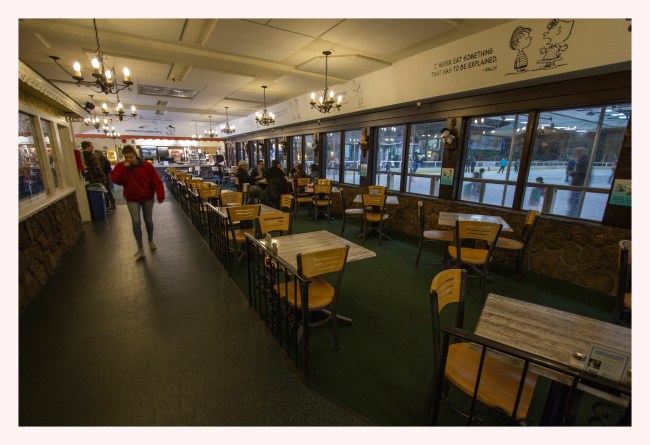
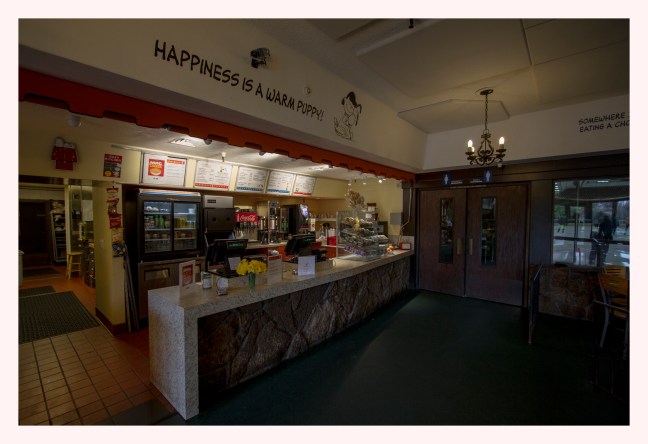
Even though Shultz passed away in 2000, out of respect for the artist who was so beloved by his community, Schultz’s favorite table inside “The Warm Puppy“ − the café at the Redwood Empire Ice Arena, more commonly known as Snoopy’s Home Ice − is always reserved for him. Shultz opened the arena, which sits practically next door to the museum, in 1969 when he sensed a need for it in his community after the existing one was suddenly was forced to close down. It’s name comes from a line in one of his Peanuts strips, “Happiness is a warm puppy,” which I think means that real happiness isn’t very complicated. I can’t think of a better embodiment of the man that I came to know just a little bit that day.


It was nearing twelve-thirty when I finally found my way back to my car. My visit to the museum and arena had been much more truncated than I would have liked, but with only two days in the area, practicality became a necessity. By then the sun had taken position at the very top of a bright blue sky, a patchwork of white fluffy clouds surrounding it. I was very thankful it had turned into such a beautiful day.
As I embarked on the wine tasting portion of the day, I knew it had been planned to perfection. My wine club membership at Lincourt Vineyards, the Foley Family winery in the Santa Ynez Valley that I adore, comes with the added benefit of free tasting at all their sister wineries, of which there are five in Sonoma County and three in Napa. After consulting with Google Maps the night before, my plan was to visit four of the five Sonoma wineries that afternoon. The first, Chalk Hill Estates, was just twenty minutes away in the town of Healdsburg.
The closer I got to the winery, the nastier the sky looked, as if my profound gratitude in Santa Rosa had caused the weather to grow spiteful. By the time I made it down Chalk Hill’s long driveway and got my first look at the palatial grounds − vineyards beautifully draped over rolling hills that surround the large building that houses the tasting room – deep gray clouds had overtaken everything blue. The first few droplets of moisture appeared on my windshield just as I pulled into a parking spot. The sight of it irritated me.

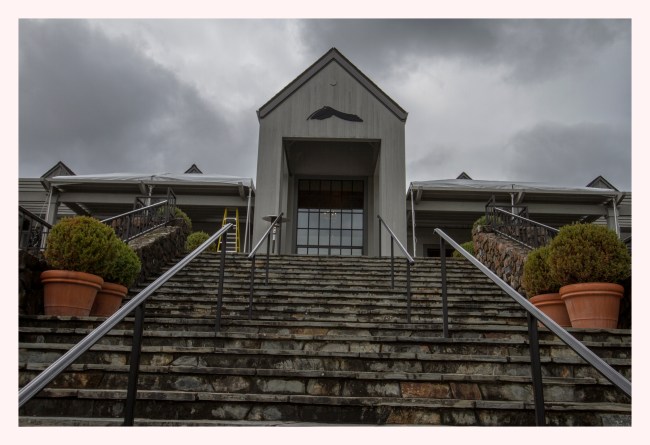
Once inside the tasting room, where subtle square moldings on cream-colored walls soothingly offset the slate floor’s sizable grey and brown mosaic, I found a rather large crowd of relatively laid-back aficionados. As I made my way through the room, I couldn’t help but notice a young man darting back and forth among them. He was attentively and almost singlehandedly serving everyone in the room at a relaxed yet breakneck pace, and also the best-dressed host I’ve ever come across in all my years of wine tasting. The modern form-fitting business casual look he’d opted for – tweed jacket, oxford shirt sans tie, khakis, and well-polished brown leather loafers – looked flawlessly stylish on his slender frame, and I was almost jealous of him. No matter how hard I’ve tried, my somewhat pear-ish shape just can’t pull the look off, and I end up resembling a disheveled Chris Farley even if everything I’m wearing is tucked in and neatly pressed. It’s a curse, really.
A few minutes later the young man approached me where I stood at one end of the tasting room’s bar, and introduced himself as Mike. We chatted for a bit as he took me through the day’s tasting menu (of which I found the 2014 Chardonnay Carol Ann Musqué and 2016 Windy Ridge Sauvignon Blanc to be particularly delightful), but a few moments after he gave me my first pour, he was gone again, onto his next lap. Yet with each pass, and with each pour, Mike managed to somehow engage in an actual conversation with me. In the few minutes allotted to me each time he made his way to my position, we talked about my plans to visit all of the Foley Family wineries in the area. On his third or fourth go around he opened our continuing conversation with “So, have you made reservations at Kuleto and Merus already?” I started to answer, but the realization stopped me dead in my tracks. It felt as if a chilled air was being pumped into the room from somewhere directly above me. In my willingness to extend the number of days I spent in a particular place, to entertain the notion of complete spontaneity, I had decided to hold off on making any reservations until the last possible moment. It was on my list of things to do the morning before, but my trip to Pixar had drawn its urgency out of my mind like the tune of a hypnotic piper.
“Do you think it’s too late?” I asked Mike, attempting to exude a cool calm, but knowing for certain that he could see the panic in my face.
“Let me see what I can do,” he said as he poured me Chalk Hill’s 2014 Malbec, which turned out to be my least favorite of the flight. He returned not long after, and I couldn’t immediately tell if he had good news or bad. “It looks like Kuleto can fit you in tomorrow,” he told me with a slight smile. “They’ll call you to confirm the exact time, but…” he went on, his facial expression turning grim, “Merus has a private party tomorrow afternoon, and are completely booked. Are you sure you won’t be in the area any longer?” I thought about it for a moment, but knew it wasn’t possible. I had already told my friends Jessica and JuanCarlos that I’d be at their place outside Seattle for a visit sometime at the beginning of March, and that day marked the first of the month. Plus, I still had a few places I wanted to visit as I moved further up the coast.
“Unfortunately not,” I told him downheartedly.
“Well, at least you get to taste at Kuleto,” he said brightly, and was off again.
When it came time to leave I knew I wanted leave Mike a big tip. He had not only shown fortitude, good humor, and skill in facing the almost endless gauntlet of connoisseurs on that Thursday afternoon, but I also knew he was the reason I had gotten a reservation at Kuleto. Except, right as my hand reached into my pocket, I suddenly remembered I stillhadn’t stopped at a cash machine. I could picture the pitiful sight of the two single dollar bills that currently occupied my wallet, then the absolute embarrassment that would come from handing a grown man, who had gone out of his way for me on a very busy day, two dollars for his effort. Immediately, my mind started racing as to how to handle the situation, but soon after, thinking of my mother, I decided honesty was my best option.
“Let me just preface this with ‘I’m sorry,’” I told Mike as he approached me for the last time. “I wanted to give you a much better tip, but for some reason I keep forgetting to stop at a cash machine.” Then, as quickly as I could, I handed him the two dollars, which I had folded I twice in half so he couldn’t see how insulting my offering actually was.
“It’s no problem,” Mike told me graciously, with a warm smile. “I never expect a tip, but thank you.” If he wasn’t being sincere, Mike is one hell of an actor. It made me feel only slightly better as I made my way for the exit.

Outside I found the sidewalks and blacktop had been darkened by another recent downpour, except somehow the sky was already a bright blue and dotted again by fluffy white clouds. I had only been inside for about an hour, but the quickly changing weather made it seem like much longer. I hopped in my car, on my way to Roth Estate, which sits directly across the street from Chalk Hill. The fact that I was driving made it almost comical, and for a moment I considered walking, until I realized it was after two O’clock and after Roth I still had two more Foley Family wineries I wanted to visit.
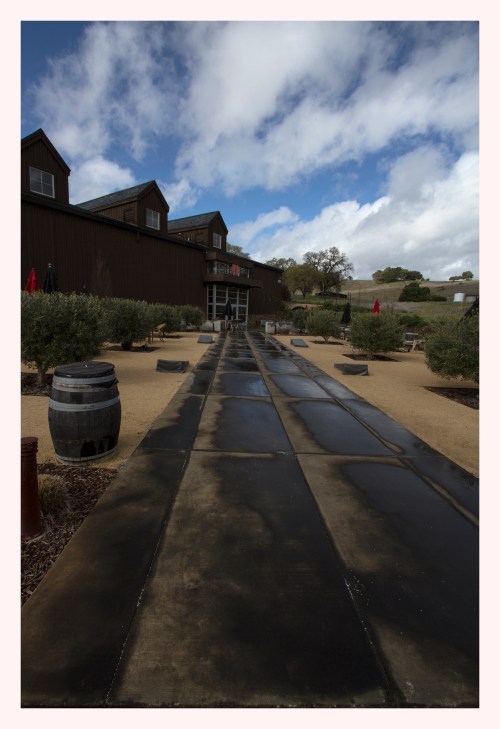
As I approached the tasting room I thought to myself, “Now this is more my speed.” I’ve said before I’m a fan of the unpretentious, and this place looked like it may have once been a barn, though in the days since converted to its present purpose with some style. Whereas Chalk Hill was quite a bit more opulent in its presentation, Roth was simple, understated, and at least approaching salt-of-the-earth. On outward appearances alone, I liked it immediately. Sadly, that opinion would not last much past the front door.
For a long time I’ve anguished over recounting happened to me in Napa and Sonoma. I’ve wondered about the benefit of divulging the utter horrors I encountered there, and whether or not I would be breaking my mother’s second rule by telling you about them. I’ve considered the truth of those two days so many times, and wondered just as often if it’s strictly personal. Yet the thing that worries me the most, the thing that has actually caused me to lose sleep, is whether or not there will be consequences if it is. Will my taste buds forever be burned away if I tell you that Roth Estate was without a doubt one of the worst tasting experiences of my life? Could my sense of smell be stripped from my skull if I reveal that my experience at Lancaster Estate and Sebastiani Vineyards wasn’t much better? I’m sure you will be happy to learn that I have opted to tell my story here, in the hope that no one will ever again have to experience the same kind of anguish I did over the course those two days. I will not be withholding any details, save for changing some of the names to protect the incompetent. Yes, I am worried that a mysteriously timed lightening bolt might turn me to ash, but in the face of such heavenly repercussions, I must be brave. Even if the truth of what happened turns out to merely be my own, I’m sticking to it. 1.21 gigawatts of electricity has never hurt me before.
Inside Roth Estate’s tasting room I stood alone at the bar for more than five minutes, waiting for someone to appear. In that time I appreciated the room’s somewhat modern aesthetic − lots of clean lines in wood and aluminum, and its curved bar made up of frosted glass blocks − but as time passed I began to question whether or not the place was even open. Finally a plump young woman, wearing jeans, a black short-sleeved top, and a nametag that read Sunshine, appeared from somewhere in the back and approached the bar. She didn’t seem to have a care in the world, and didn’t even bother to speed up when she noticed I had been waiting. “Are you here for a tasting,” she asked me.
“Yeah,” I replied with nod, and forced myself to smile even though I wasn’t feeling it.
“Great,” she said in a tone that teetered on ironic, produced a glass, and poured me their 2015 Russian River Valley Reserve Pinot Gris, my favorite of the flight. When she was done, without a word, Sunshine disappeared again.
As I stood there, listening to the echoes of slamming doors from those moving about in unseen nooks near the tasting room, I started to wonder what kind of opposite-day, parable-approaching nightmare I had wandered into. At Chalk Hill, even though he was exceptionally busy, Mike was polite, attentive, and accommodating. This girl was none of those things. Darkness had found me at Roth Estate, and its name was Sunshine.
In the hour I spent there I shared maybe a half a dozen brief exchanges with Sunshine, all of them functional and perfunctory. The absence of other patrons did nothing to increase her attentiveness towards me. She would vanish to the wineries nether regions after each pour, and when my taste was finished I would have to wait at least five minutes for her to reappear and give me the next. I spent more time surfing on my phone than discussing the wine, a fact that I can excuse during times of great busyness, but not because of laziness. Yet, I would have let it go. I would have moved on with my life and saved myself months of inner torment. I would have happily forgotten about my time with Sunshine had it not been for the 2015 ‘Meola Vineyard’ Alexander Valley Cabernet Sauvignon.
It was in the fourth position on my tasting menu. I’d waited for over ten minutes since finishing my taste of their 2015 ‘Trenton Road Vineyard’ Russian River Valley Pinot Noir – its overly long name about as pleasing on my tongue as the wine. My animosity by this point had grown so large I was mere moments from detonation. But Sunshine, and her immense talent for ineptitude, found a way to make it worse. When she reappeared momentarily from the fiery pit of hell where I was sure she was moonlighting and started carelessly searching through the handful of wine bottles below where I stood at the bar, haphazardly shoving them into each other with loud percussive crashes, I decided it was time to speak up about my displeasure. But just as I opened my mouth to give it voice Sunshine brandished her index finger like a weapon, an indication that she really couldn’t handle doing two things at once, and that I should wait to speak. Then, without an actual word, she turned away from me and started searching the back bar for what I assumed was the wine I was about to taste.
I fought the urge to jump over the counter and murder her. I was seconds from losing the battle when she turned to me and said, “Guess we don’t have any up here. I’ll be right back,” and disappeared once more to her sanctuary of fire and brimstone and buffoonery.
I wanted to leave. I wanted to escape from Sunshine like I’m sure everyone in her life has at one time or another. But I couldn’t stop thinking about the bill. Somehow the idea of it got lodged in my mind and the thought made me incapable of carrying myself out the door. The fact that there wasn’t going to be one, because of my aforementioned Foley Family membership, didn’t seem to make any difference. I kept telling myself that I have never dined, or wined, and dashed, and that Sunshine was not going to be the driving force behind me breaking bad for the first time. I would not relinquish that much power to an idiot.
It was another five minutes before she reappeared again. “Sorry about that,” she told me. I said nothing, worried that if I opened my mouth I might literally bite her head off. She opened the newly acquired bottle and gave me a pour before taking a step towards the door she had just come through.
“I’d like to settle up, if you don’t mind,” I said to her before she could leave, and plopped my membership card onto the counter with a loud snap. She eyed me for a moment. It was clear my request confused her. I responded with a smile, and sampled the small taste she had just poured me. It certainly wasn’t worth the wait.
It took Sunshine another ten minutes struggling at the POS terminal to check me out, but in that time she let me sample their 2015 Roth Estate ‘Heritage,” my second favorite of the flight. Along with the fact that I had no cash in which to guilt myself into giving her a tip, it meant that I left Roth Estate at least somewhat satisfied.
On my way to Lancaster Estate, which is just five miles down the road from its sister wineries, I considered stopping at an ATM. A quick search on my iPhone revealed that the closest one was quite a bit out of my way, and after what I’d just experienced my inclination towards tipping was gone.
By the time I reached my destination, the skies were turning ominously gray once again. The air outside was noticeably colder and damper than it had been earlier in the day, and it felt like any sporadic appearance of the sun was now out of the question. I pulled down another long driveway, and eventually found my way to a beautiful European inspired tasting room. It seemed warm and inviting, and a place where I might find some measure of care and attention during my visit. Yet just like Roth, Lancaster Estate was intent on deceiving me. I didn’t realize that its ivy-hugged sand colored walls held a devious secret, and that after I walked through the doors I might never be seen again.

As soon as I entered I sensed something amiss. The tasting room’s vestibule − strangely unlit, and so as cold and gray as the weather outside − evoked a unique sense of dread.
Cautiously, I moved towards the bar, and behind it, I found a man. I remember it was a man because I distinctly recall his beard. I also remember the timbre of his depressingly drone voice as he greeted me with a flat, “Hey.” But oddly, beyond that, there is almost nothing. Even though I would have changed it here, I didn’t even bother to jot down his name. It just seemed unimportant. What I do remember, what sticks vividly in my mind, is that during the course of a four wine flight he failed to utter more than ten consecutive monotone words to me at a time.
“You tasting today?” he finally continued after a long uncomfortable pause, as if I was just there to awkwardly stare at him.
“Yes,” I said in as friendly a tone as I could muster.
He gazed longingly out the window at the end of the bar for a moment, like a disinterested kid in class, before placing a wine glass in front of me. “This is our Reserve 2016 Sauvignon Blanc,” he mumbled as he poured, as if any hint of emotion might cause his head to explode.
I took a sip, and found the wine to be quite enjoyable – fruit forward and well balanced − and for a moment it looked as if the experience wasn’t going to be as dismal as it appeared. Then I made the foolhardy mistake of glancing around the oddly silent tasting room.
That’s when I noticed the elderly couple.
They were seated at the other end of the room, where two sets of leather armchairs, separated by a small wood slat coffee table, were positioned. Besides my jubilant host, they were the only other people present. But immediately I recognized something was off. Each of them held a wine glass with a few sips of a deep red liquid hanging at the bottom, but neither seemed to be drinking it. They just stared at each other from across the table like statues.
I watched them for the amount of time it took me to finish my first taste, and move onto the second, a cuvée that I found unremarkable. In those ten minutes − ten minutes in which my host stared out the nearby window as if in a trance − neither of them moved a muscle, nor spoke a word. In my ample number of years I’ve watched enough sci-fi/horror anthology series, from The Twilight Zone to Dark Mirror, to know for sure how they end. But that was the first time I’ve ever felt witness to one. The feeling was so vivid it seemed that at any moment Rod Serling was going to walk out of the shadows, and in his distinct voice bring my episode to its visceral and haunting conclusion. “Scott Watts was an oblivious wine snob for whom the flavor of life could only be found inside a bottle. Little did he know that on a trip to find himself, he would find himself trapped inside a bottle of a different sort. Except this one is devoid of any flavor, and can only be sampled inside “The Twilight Zone.”
I quickly downed the cuvée and requested my next sample, the first, and in my opinion lesser, of two cabernet sauvignons. “Okay,” my host agreed monotonously, and once the wine was in my glass I grabbed it from the bar and hurried back towards the vestibule.
“I’m gonna go explore,” I told him curtly as I made my escape. Yet no matter where I went, whether it was the dramatically lit wine cave (a subterranean space for storing and aging wine), or the eerily quiet private tasting rooms, the feeling of impending doom persisted. At no time did I see, or even hear, another living soul, so it didn’t take my lizard brain long to decide it was time for flight.
I practically sprinted back to the bar. There I found Mr. Personality still staring wistfully out the window and the old couple in the same position as when I’d left. A sip of wine may have been absent from each of their glasses, although I couldn’t be sure. I didn’t leave immediately, though. There was still one more wine to sample, and no matter what kind of ironic danger hung in the air I had an obligation to finish what I’d started. And my bravery paid off, because Lancaster Estate’s 2014 Cabernet Sauvignon was my favorite of the flight. So, just like at Roth Estate, I left feeling somewhat satisfied. Although I’m sure I kicked up a lot more gravel as I sped back towards the main road, and the relative safety of the real world.
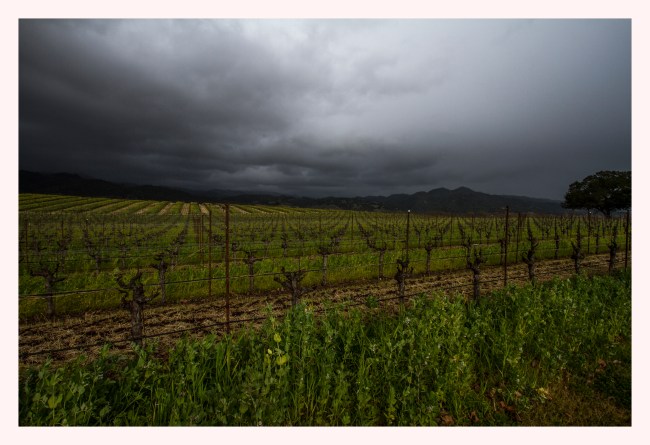
As I grew nearer to my last stop of the day, I made a very pointed effort to temper the remnants of my diminishing enthusiasm. But as I traversed Foley Sonoma’s long driveway, moving towards their modern yet rustic tasting room, it became markedly harder. Once inside, it was nearly impossible not to fall for the place. Poured concrete walls perfectly complimented a beautifully stained wood plank ceiling. Square tube-steel stanchions supported glass walls that offered panoramic views of the beautiful grounds and blackening skies outside. Yet despite everything I found deeply appealing, it still felt like just a matter of time before the other shoe fell.
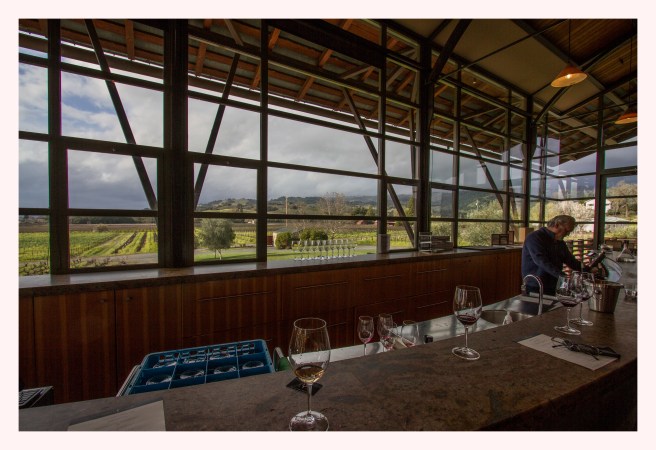
I surveyed the tasting room, which was quite crowded when I arrived, and headed directly for the bar. It seemed like the best place to find an unoccupied spot. As fate would have it two middle-aged women headed towards the door just as I approached, creating a hole next to an older man who stood facing a strikingly attractive young blond woman. I slid my way into tasting position, naturally curious as to what their relationship might be, and waited for someone behind the bar to notice me.
“How many cases do you think we should get?” I heard the women’s voice chirp a moment later.
“We’re here, so we should get enough for awhile,” the man answered brusquely.
“Okay,” the woman complied with an obsequious pout, and out of the corner of my eye I could see her raise her hand in an attempt to get the attention of the host closest us, a distinguished looking man in his sixties with white flowing hair.
“Have you decided?” he asked them.
“Yes,” the woman said cheerfully, and from her tasting menu started reading off a list of wines that made my head spin; two cases of this merlot, three cases of that zinfandel, five cases of this cabernet sauvignon, ten cases of that chardonnay.
“That’s a lot of wine,” the host said when she was finally finished.
“We need it,” she told him pragmatically. “’That’s why we’re down here for the weekend, from West Mercer, to pick some up. This is only our first stop.”
“And she drinks a lot of it,” the man added snidely.
“We both do,” she rebutted in embarrassment, and I could hear the man, who stood to my right with his back towards me, take a deep breath. I sensed the hostility it carried. The host made a few last notes to himself on a piece of paper before he moved away to start putting together their order “for shipping” as the woman had cheerily, but vacuously, instructed him.
“Why do you always have to invite everyone into our business?” the man lashed out as soon as the host was gone.
“I was just being friendly,” she told him. “You’re so paranoid.” I didn’t want to listen, but it was hard not to hang on their every word.
“You were being friendly by telling him where we live?” the man shot back. “He does not need to know.” It occurred to me that my position behind the man completely concealed me from the woman’s view, and for a few seconds I considered making my presence known.
“He’s shipping us the wine,” the woman clapped spitefully. “So I’d say he needs to know.” There was something about the way she said it that caused a deep excitement to rise in me. I can’t really explain it. So instead of revealing myself, I trained my head forward, thinking it prudent after my experiences at Elephant Seal Vista Point, and attempted to look like I was minding my own business.
“That’s besides the point,” the man said, the frustration in his voice growing. “You know why you told him.”
I had no idea what they were talking about, so I pulled out my phone, and inconspicuously searched “West Mercer.” One of the first hits I got indicated that West Mercer, on Seattle’s Mercer Island, is known as its “Gold Coast.”
“Sounds fancy,” I thought to myself, just as I heard the man’s voice speak the words “I’m surprised you didn’t tell him we took the jet down here.”
The what? For a split second I was sure I misheard him. That maybe he had said the ‘Vette, or something even approaching prosaic, but the further search I was just then conducting on Wikipedia told me that Mercer Island is one of the most prestigious addresses in the Seattle area, where people like the cofounder of Microsoft and the CEOs of Ford and Boeing live.
“Who were these people?” I wondered. And was it appropriate to ask them for a donation?
“You’re an asshole,” the woman fired back.
“I am,” the man told her. “And I’m not going to apologize for it. Finish buying your wine, I’ll be in the car.” And wouldn’t you know it, just as he turned to leave the man finally caught glimpse of me. He knew immediately I’d heard every word they’d spoken to each other, and eyed me intensely as he passed. As he did I pictured him heading down to a stretch Range Rover in the parking lot and instructing the driver to alert The Liquidator that he had a “job” for him. Imaginary or not, it was a sobering thought.
A few minutes later the woman finished her purchase, and when she was gone the host, who later introduced himself as Brian, finally approached me with a knowing grin.
“She seems like a very expensive taste,” Brian told me when he reached my position at the bar, his grin transforming into a sly smile. “Sorry about the wait. You here for a tasting?”
“Yep, and no worries,” I told him, appreciating his wonderfully acerbic sense of humor. “That was… educational.”
Brian may have been my third favorite thing about my visit to Foley Sonoma − after the jet setters and the beautiful setting, but before the wine (though their 2016 Russian River Pinot Noir and 2014 Alexander Valley Oz Zinfandel were particularly memorable) − but talking with him was a real treat. During the course of our conversation I learned that, like me, he was from the east coast, and had retired to the area. When I asked what brought him to Foley Sonoma he replied, “My wife not so gently suggested that I get a job,” and with another sly smile added, “She was really trying to get me out of the house before she killed me.” I can’t overstate how much I appreciated Brian’s wit and loose sense of professionalism, and it really bothered me, when time came to leave, that I couldn’t leave him a generous tip. Even hours later Sunshine’s colossal degree of incompetence was finding new ways to stoke my ire.
It wasn’t until around noon the next day when I finally managed to make it to a cash machine. I’d planned to stop first thing that morning, but the drunken woman who started pounding on the door of my motel room at 4 AM pretty much guaranteed a late start. I’d spent the evening getting some work done and searching for a hotel room somewhere near Humboldt Redwoods State Park or Ferndale, California, where I planned on exploring the next day. After finding what I was looking for at the Motel 6 in Arcata, about four hours north of Napa and Sonoma, I finally turned in. I was hoping for six good hours, except just as I found a deep comfortable sleep, the pounding began. It sounded like a SWAT team, and woke me in terror. I rushed to the door, but a quick look through the peephole revealed a woman struggling to stand and slurring her speech as she began yelling, “Murk-uh, let me in. MARK-UHHHH!” Without unlatching the swing bar I opened the door, and peeked through the crack. The woman narrowed her eyes and while swaying muttered, “Ya not Mark-uh.”
“No,” I said tersely.
“Mark-uh not here?”
“No,” I repeated, at which time she turned and wandered away. But by that point I was wide-awake. It ended up being a very restless night.
From the moment I opened my eyes the next morning, greeted by the sight of pouring rain outside my motel room’s window, I debated whether or not I should just get on the road and continue my journey north. The drab cold of the silent room seemed to perfectly frame the mixed results of the previous day, and I couldn’t shake the thought that a better outcome might be unrealistic, even though I knew precisely what was turning my mild disappointment into this negative melancholy − the fact that the day marked one year since I’d seen my former fiancée for the last time. For ten minutes the internal debate raged, before finally I got out of bed, turned on the shower, and reminded myself that nothing was going to prevent me from enjoying my last day in the area.
After stopping at the ATM and withdrawing enough cash for at least the next week, I headed for Sebastiani Vineyards and Winery, whose tasting room sits within the small town of Sonoma. I was struck by the oddness of its location, especially as I travelled through a residential neighborhood during the last quarter mile, and wondered whether or not it might be geographically separate from the activities that produce its wine. Like I’ve said before, I like to go where the berries are cultivated. Where I can see for myself the literal fruit of so many people’s labor, and Sebastiani’s location made me question if that was even a possibility. The answer, I hoped, would come during my tasting.
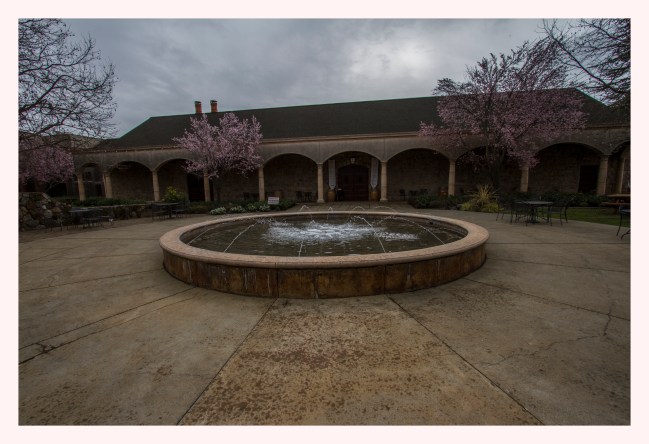
Once again I waited at the bar for an exorbitant amount of time before someone acknowledged my existence. But unlike at Roth, Sebastiani wasn’t empty − quite the opposite, in fact. It was midday on a Friday, and the weekend was just getting started. At least a few people seemed to be exploring every nook and cranny of the luxurious, yet cavernous, tasting room, and there were more than a dozen people taking up position along their marble-faced bar, which seems just a few feet shy of extending into infinity. Frustrated by the ignorance, I decided to do some exploring of my own.
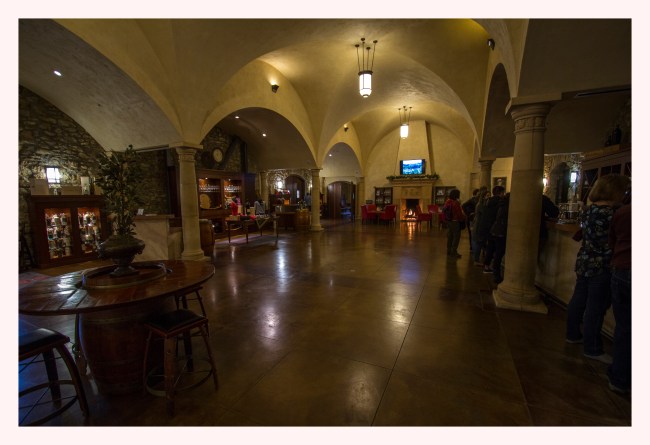

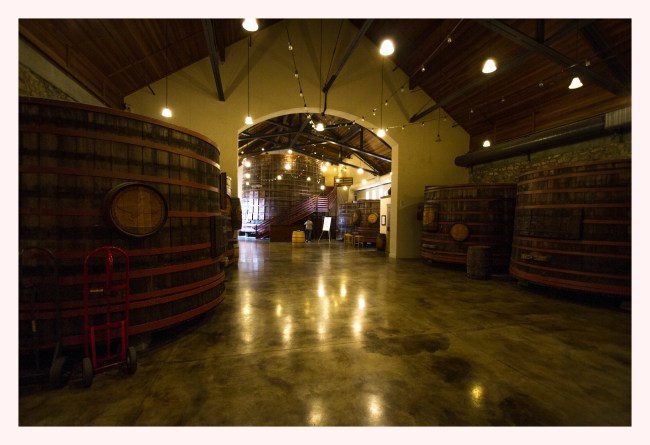


I made my way through the tasting room, the groin-vault ceilings and raw sienna polished concrete floors a bit much for my tastes. The entire place felt oddly manufactured to me, and after mingling amongst giant wine barrels that ostentatiously towered above me, or protruded from walls, I grew bored and returned to the bar. There, I waited again. Finally, after a few minutes, I managed to get the attention of a woman named Elaine. She was hard-eyed, middle-aged, and greeted me dismissively with the bewildering phrase, “Yes? May I help you?”
The way she had said it inferred that I couldn’t possibly be there for a tasting − that I didn’t have the right outfit, or stock portfolio, or some other thing. After the couple I’d experienced at Foley Sonoma, and the fact I’d heard on more than one occasion that wine enthusiasts who frequent the area could be unabashedly snooty, it wasn’t necessarily a surprise. Yet my severe distaste for any manner of snobbery bred in me an insatiable desire to say something sarcastic. I could feel the urge bubbling up like a volcano. I wanted to give Elaine some manner of attitude, something that would convey my extreme displeasure with her denigration. After a few seconds of intense thought I came up with the biting zinger, “Yeah, I’m here for a tasting.” Elaine gave me a sideways glance, and I thought to myself, “Good one!”
For the life of me I couldn’t figure out what she saw in me, or failed to see, that indicated to her that I didn’t deserve some small piece of respect. In her eyes, did I not hold the refinement or class that made me worthy of a sampling of Sebastiani’s holy nectars? Or was it simply that Elaine was a wretched and rude human being?
As she poured me their 2014 Steel Chardonnay, a crisp and refreshing delight that had wonderful notes of apple, vanilla and kiwi, I tried to make friends with Elaine. “So how’re you today?” I asked her with a smile.
“I’m fine,” she said curtly, before moving back down the bar to be with those whom I took to be the cool crowd.
Twenty minutes later, after twice giving Elaine an awkward but friendly nod when she poured me my next taste, I tried again. Deciding it time to pose the question that had been plaguing me since my arrival, with innocent eyes and an inquisitive smile I asked, “Where are your vineyards located?”
Elaine eyed me as she poured, her hostility as plain as her hatred. From the intensity of her look I could feel my stomach tightening. When she was done, Elaine lowered the bottle, and like a Dilophosaurus spit a condescending Mean Girls version of “They’re right here” directly into my face.
“Oh. I just thought, since this was a residential neighborhood…” I tried to explain, but Elaine cut me off before I could finish.
“They’re a block northeast of here,” she snapped, and then viciously added, “Can’t very well have a winery without a vineyard, now can you?” And without another word Elaine made her way back down the bar, eyeing me for as long as she could.
I wanted to tell her off. I wanted to make sure that she understood her brother, Beelzebub, was much nicer than her. But somehow it didn’t seem worth it. Elaine didn’t strike me as the type that learned anything, or gave even the tiniest portion of a rat’s ass about what I thought.
I did have my revenge, though. Before I left, as I was settling the bill with my Foley Sonoma membership card, I made a point to ask Elaine to change one of the new twenty-dollar bills I had gotten from the ATM. “A ten, a five, and five ones,” I told her.” A few moments later, after our business had been concluded and she escaped from my spot at the bar one last time, I ripped a small slip of paper from one of the nearby tasting menus. On it I wrote, “Thou shalt be less awful,” folded it into a single dollar bill, and left them underneath the base of my wine glass. And even though I was long gone by the time she saw it, I like to think that it made Elaine hate me even more. The thought always brings me peace.
Back in my car, on my way to Foley Johnson, I noticed my tank was nearing empty, so I kept my eyes peeled for a gas station along the route. The few I saw were just a bit out of my way, down an off-ramp or crowded street, and with a scheduled tasting at Kuleto at two-thirty, I made the questionable decision to wait until one presented itself. None ever did. So by the time I reached the winery more than thirty minutes later my fuel situation had me a little on edge.
I discovered Foley Johnson’s tasting room down a markedly short driveway; it’s modest gable roof drawing me closer. Once parked I got my first good look at the almost provincial building, which is wrapped in a delightfully weathered way by wooden board and batten siding. A covered trellis draped in leafless ashen grapevines led the way to its front entrance.
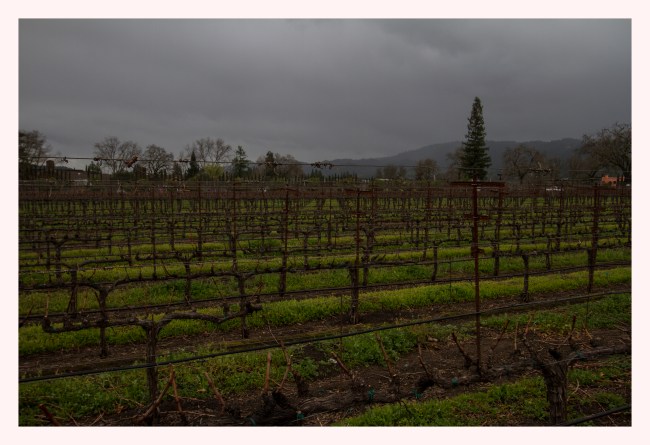

As I pulled the door open and stepped inside a comforting sense of warmth immediately enveloped me. Calming music filled its bright interior, and for reasons I can’t precisely explain, it felt as if I was arriving home.
As I moved into the tasting room a Golden Labrador, who would be later be introduced as Nala, came hurrying towards me. Her tail wagged furiously as she excitedly tossed, and then caught, a tennis ball in her mouth. Nala followed my every step as I moved towards the bar, trying desperately to get me to play with her. I bent down with the intention of petting her, but the moment I did Nala withdrew to a place just outside my reach, the tennis ball awkwardly hanging from her mouth. When she was happy with the spot, Nala let herself fall backwards and landed with a hollow thud, eyeing me intently from her reclined position. She seemed to be pleading for a game of catch.

Deciding that it probably wasn’t the best decision in a tasting room, I stood and sidled the rest of the way to the bar where I met Jen, an attractive twenty-something who greeted me with a very friendly, “Hello!” After my interactions with Elaine it felt like a warm hug.
“Hi,” I reciprocated, trying to match her affability.
“You here for some wine?” Jen asked.
“Sure am,” I told her. Jen pulled a glass from somewhere under the large curved bar and placed it in front of me before retrieving a bottle of their 2016 Estate Sauvignon Blanc.
“Been anywhere else today?” Jen inquired.
“I just came from Sebastiani.”
“How was it?”
“The wine was nice,” I told her truthfully as she finished pouring me a sample. I swirled the wine around the glass a few times before taking my first taste. It was refreshing and crisp, with delicious notes of kiwi and passion fruit.
“Going anywhere after this?”
“Uh yeah, Kuleto,” I said, a bit distracted by the wine that was still unfolding on my palette.
“Oh, that driveway,” Jen exclaimed with wide eyes. “Have you heard about their driveway?”
“No,” I answered, a bit startled by her reaction. Jen’s eyes widened even more.
“It’s one lane,” she continued. “And in this weather?” By that time it was pouring outside. Instantly I forgot about the wine.
“It can’t be that bad.” I said, trying to fight off the vivid mental images my imagination was concocting. From the shrug of her shoulders and roll of her eyes I could tell Jen didn’t agree. For a moment I wondered if her assessment was personal truth, or something that actually warranted the level of anxiety that was rapidly building inside of me.
“What’s so awful about it?” I asked, attempting to sound calm.
“It’s on the side of a cliff,” Jen said, “And it’s like two miles long. So if someone is coming down while you’re going up, one of you has to reverse.”
I couldn’t help but think of Pat, his Friday night movie plans with his girlfriend, and the Albany Department of Public works. I knew Jen wasn’t out to ruin my experience at Kuleto, but hearing about her impressions of their questionable driveway certainly didn’t make it feel that way. Up until that point my ignorance had been absolute bliss, but Jen’s chilling words ruined it. And now I was paying the price!
I felt the urge to introduce Jen to my mother’s second rule. “You know,” I wanted to say to her, “If you don’t have something nice to say, you shouldn’t say anything at all.” But instead I thought of Pat again, and his most oft repeated phrase to me.
“Would you like some whine with that cheese?”
 Dislocated