

I stood on the paved trail that had guided me through Bothin Marsh Preserve, hesitant to go any further. The sun was only minutes from dipping below the horizon behind me, plunging the pedestrian underpass that crosses beneath the 101 Freeway into near complete darkness. I knew my friend Fro’s office was just on the other side of it, but either my sixth-sense or my paranoia was telling me to proceed with caution. Of course, I didn’t know which.

I’ve told you before that I’ve seen too many movies, and watched far too much television over the years. While it has its advantages, mainly the narrative shorthand it provides when talking story with people who work in the same industry as I do, it’s also something loaded with unintended consequences. Besides the fact that I’ve spent untold hours in a sedentary state, lounging in dimly lit rooms while happily avoiding the real world, all those hours of viewing have exposed me to any variety of horrible scenarios the aforementioned real world could, in theory, plop down right in front of me without warning. What was plaguing me in that moment is one I like to call “The Law of the Happy-Go-Lucky Doofus.” I’m sure you, like me, have seen it before, in everything from slasher flicks, to lowbrow comedies, to 20/20. In said scenario an oblivious halfwit, who up until that point has been experiencing a stellar afternoon complete with sunshine, an unnatural number of kind strangers, and maybe even some joyful whistling, fails to recognize their surroundings right up until the moment when he or she wanders into the wrong situation. Then, quite suddenly, the music changes, the scene darkens, and from the shadows said danger creeps, instantly throwing our doofus right into the thick of it. As I stood just outside the underpass, that was the first thought that occurred to me. A second, equally upsetting, quickly followed.
It’s not only in movies and television where the entirely avoidable dangers of the real world have been memorably highlighted for me. Because I like to travel, I’ve read a my fair share of guide books where the likes of Rick Steves, Frommers, or Lonely Planet lay out the hazards of leaving home as laconically as possible. It gives their warnings an almost scientific tone, which in my opinion makes them all the more terrifying. So of course, as I stared into the abyss on that chilly February evening, my rich yet ill-timed imagination concocted, in cruel detail, a passage that would make Rick Steves proud.
“Bothin Marsh Preserve in Mill Valley California, just north of San Francisco, provides the work-a-day masses of this affluent community a picturesque place to walk their dogs and jog, but one must be aware of the possible dangers present after dark. Over the last few years, authorities have begun warning lone travelers about venturing into darkened underpasses after daylight hours. A ravenous nether-creature, they say, hungry for kills and coin, has taken up residence here, much to the chagrin of Mill Valley residents.”
What can I say? I’ve seen and read all the right things.
For moments I faced the underpass unmoving, my mind racing from one scenario to the next that would most certainly end with my brutal demise. From the darkness, just loud enough to make out over the buzz of the fast-moving traffic above, I’m sure I heard a shrill whisper calling out to me. “It’s perfectly safe in here,” it echoed reassuringly, sounding conspicuously like that disembodied voice in Twelve Monkeys. A second later it was Pennywise from Stephen King’s It who called out. “They all float down here,” it beckoned in its extra-hypnotic way, the words, in my mind, translating to “You are going to die a brutal death you dumbass!”
When I took it out of my pocket, my phone viciously alerted me that it was just moments from the time I was to meet Fro. Catching the Number 4 – Mill Valley bus had already cost me a lot of time, and now I was voluntarily wasting more. I turned and looked around, hoping to find other people in close proximity that might hear my unnatural shrieks if things in the underpass turned murderous. There was no one. The closest soul was maybe fifty yards away, and she was running with her dog in the opposite direction. I knew I had a grave choice to make. So, I did what any person who places a high importance on punctuality would do – I pushed my fear down as far as I could, took a deep breath, and stepped cautiously into the abyss.
The music changed.
The scene darkened.
And from the shadows nothing at all happened.
In my long-ish journey underneath the 101 Freeway, I encountered no form of danger. No bird with questionable sight or homeless fellow with questionable sobriety. I was through the underpass in just a couple of minutes, and on my way to meet Fro. Somehow it felt like one big anticlimax. I’m sure you would agree.
When I finally greeted Fro at the door of his office building, it was like no time had passed. We shared a friendly hug, and as we moved into the building Fro started telling me about the plans he’d made for us that night. Through our texts in the days before he had proposed going to a comedy club, and I agreed that it sounded like fun. Though I was expecting a dingy club like the ones I am used to in L.A. – dark and cavernous and small – but as he talked, I started to get the impression that we were going somewhere entirely different.
“You’ve never heard of the Throckmorton?” he asked me.
“No, I don’t think so.”
“It’s not far from here. They have stand-up shows on Tuesdays. I go as often as I can, especially when someone visits. Robin Williams used to do unannounced sets there before he died.” I was more than intrigued.
It had been almost been ten years since I met Fro at a wedding in Cleveland, both of us members of the wedding party. Fro was a groomsman for his friend Michael, and I was a man-maid (or maid-man, the much more masculine and gangster-flick friendly way I prefer to classify my role) for my friend Cynthia. He and I, along with the rest of the wedding party, hit it off almost immediately. It was after the rehearsal dinner that Friday night, during which all but one of us had proceeded to drink much more than we had eaten, that our bond was cemented. At around 11 PM, upon learning Cleveland was one of the few places in America where a drunken Los Angelino (or San Franciscan in Fro’s case) could score some White Castle, we made the same inebriated pledge as Harold and Kumar – that even if it killed us, we would end the night with our fill of their diminutive burgers. The next day I learned from the father of the bride that we might not have been too far off. “You’re all lucky to be alive,” he told me quite bluntly during the reception. Apparently, the White Castle we’d visited wasn’t in the best of neighborhoods, but by that point it didn’t matter. We had all survived, and each of us had happily consumed upwards of half a dozen burgers – with fries and drink. I still look back on that night and smile, and visit Fro whenever I’m in San Francisco.
After tying up a few loose ends, Fro was able to call it a day, and we jumped into his SUV ready for our night of adventure.
“I was thinking we’d get dinner at Super Duper,” he said to me as we pulled out of his office complex. I could see the pedestrian underpass in the distance. It was still taunting me.
“What’s that?” I asked.
“Burgers,” Fro said somewhat taken aback. “Aren’t there Super Dupers in L.A.? “
“I don’t think so,” I told him, momentarily questioning why he was asking me. Fro is from Southern California, after all.
“Well, you’re in for a treat,” he said a bit confused, then continued unfazed. “And it’ll be quick so we can get a drink before the show.”
“Sounds good to me,” I told him enthusiastically, more than ready for a little lubrication after my manufactured encounter with death.
Fro was right about Super Duper Burger. It was most definitely a treat. I got their Veggie Burger, and at extra cost added the recommended jack cheese and avocado. Mixed with the hummus, cucumber, and “special sauce” it already included made the burger a symphony of complimentary tastes and textures. I wasn’t expecting so much from a hamburger joint, especially one that on the surface seemed a bit pretentious due to its ultramodern approach to fast food, but by the end of my meal I was seriously disappointed that Super Duper wasn’t in Los Angeles (which proved to be the case after a quick iPhone search). I most certainly would have been a regular.
After our meal we hopped back in Fro’s SUV, on our way to the village that sits at the center of Mill Valley. We quickly found a parking spot on sleepy side street, and as Fro led me towards Playa, a restaurant bar just a stone’s throw from the Thromorton, I quickly came to appreciate this tiny hamlet nestled just outside one of America’s largest cities. To me, it felt like some small middle-American town that has been ripped from some indeterminable yesterday.
A few minutes later we reached the restaurant and ventured inside, welcomed by warm incandescent light provided by a half-dozen fixtures made up to look like enormous Edison light bulbs. From the patio just opposite us bright blue lights cast an otherworldly accent through floor-to-ceiling windows. We wasted no time in sauntering up the bar, ordering a couple of craft beers, and getting down to the business of catching up.
When our drinks were finished I suggested ordering another round, but after a quick glance at the time and Fro’s assurance that they had beer at the theater, we decided it was best to head to the Throckmorton.
We made our way back out into the crisp February night, away from the warmth and life of Playa, and set off towards the theater, officially known as 142 Throckmorton. The hour had left Mill Valley mostly vacant, yet as we moved closer to the theater, a palpable energy began to fill the air. It didn’t’ take long to realize it was the Throckmorton. It stood out like a beacon compared to the rest of the sleepy village, it’s plain cream walls contrasted by bright Tibetan prayer flags that hung above its entrance, a sign proclaiming “Tuesday Night Live Comedy” just below. When we arrived we got on a line that was maybe ten people deep, and before long moved into the lobby where a friendly middle-aged woman checked our tickets. “Enjoy the show,” she said cheerfully as we moved past her.
Despite some flourishes in the entryway’s woodworking, a ticket booth that in its own way resembled a pagoda, and eclectic artwork that hung on the lobby’s plain white walls, the theater was relatively simple in its presentation. Besides the art, the feature that struck me the most was its beautifully stained doors, windows and hardwood floors. Yet its modest décor did nothing to distract from the fact that the space felt completely and entirely alive. Creative energy seemed to ooze from every fixture and fitting, as if years of artistic endeavor had soaked into them like a sponge, when in fact, it had.
What is now known as 142 Throckmorton Theater began its life in 1915 as the Hub Theater. In those days it was home to live vaudeville acts and silent films with accompaniment by an organist. Once it even hosted a live performance by Charlie Chaplin. However, the Hub’s existence was short-lived. In 1929 it was forced to close its doors when a new theater showing “talkies” opened nearby. In the years following the building housed a skating rink, a bowling alley, and a Lodge for the local Odd Fellows Temple #399, but it wasn’t until forty-five years later, in 1976, that the space was used to show movies once again. That year a program that came to be known as “Saturday Nite Movies” began, and foreign films started screening in its auditorium weekly. Over time the event evolved into the Mill Valley Film Festival, but the theater itself was not as fortunate. It fell into disrepair, and was all but abandoned. It took almost thirty years for someone to once again see its potential. That woman was Lucy Mercer. In 2004 she purchased the building, dubbed it 142 Throckmorton Theater, and in the intervening years has grown it into a multi-genre performing arts center that attracts an audience of over 50,000 people per year, not counting the thousands more who visit the gallery space in the theater’s lobby.
As Fro and I moved further inside, I noticed the concession stand that was selling the beer he’d promised was there. The sight was very welcome after missing the opportunity for a second round at Playa. “You want one?” I asked Fro.
“I’ll have a water,” he told me. “Since I’m driving.”
“Okay,” I agreed, admiring his responsible choice. I considered doing the same for a moment, but the thought was quickly followed by the realization that for the first time in well over a week I didn’t have to drive, so I stayed the course. I really wanted a beer, and felt it would be cruel and irresponsible to deviate now. I even went back for a third during the show.
It was just a few minutes before seven when we finally entered the theater. My first impression was that it seemed like an eclectic mix of two contrasting elements, and the uniqueness of the whole struck me in an odd way. The space itself had everything one would expect from a classic movie palace, just on a much smaller and less opulent scale. An ornamented proscenium arch hung at the front, a small balcony stood opposite it, and a couple of box seats were inset under smaller arches along each wall in between. Painted on the ceiling was a mural depicting a welcoming blue sky, with white fluffy cumulous clouds, a sun and a moon. Yet instead of the plush red seats I expected to find at ground level, black folding-chairs stood in their place. I was sure it was to make the space as adaptable as possible, but it reminded me of the spring concerts I performed in during elementary school, when our gymnasium was fitted with rows of similar chairs facing the risers where we belted out classics like “Spring, Spring, Spring” and “The Sun Plus Water Makes Everything Green.” The effect made me feel almost schizophrenic. If I looked up I felt like I was standing in a muted version of the Pantages Theater in Hollywood. If I looked down I had flashbacks to tiny cartons of chocolate milk and skinned knees on the playground. I didn’t have too long to dwell on it, though, because before I knew it the lights dimmed and our emcee for the night made his way onto the stage.
After watching fifteen minutes of the Throckmorton’s show, it became even more apparent to me that I was not at The Comedy Store or Laugh Factory. The sets that I was enjoying were tight and polished, and would have been more at home in an HBO special than an evening at one of the two aforementioned venues, which on some nights see more bombing than Berlin during World War II. Out of the handful of comics Fro and I saw that night, two in particular stood out to me. The first was a young man named Connor McSpadden, who looked only slightly older than the kids in Stranger Things, but had a razor sharp wit that mixed perfectly with his aw-shucks kind of innocence – to hilarious results. The second was a comic named Auggie Smith. Auggie has a rather nasally high-pitched voice to begin with, but to emphasize his point he would often take things up a level, screaming in a tone that teetered on the threshold of dog whistles. When he launched into a bit about the Emergency Broadcast System, culminating with his passive-aggressive approximation of the sound the alarm makes with his car-belt squeal of a voice, Fro and I laughed so uncontrollably that tears ran down our faces and it seemed impossible to catch our breath. After the preceding few days on my quest for closure, it was exactly the kind of laugh I needed.
It was nearing nine when the show ended. Fro and I made our way back outside feeling electrified. Mill Valley felt one step closer to being a full-on ghost town, and the invigorated patrons of the Throckmorton spilling out into the street provided a strange juxtaposition. As Fro and I talked, heading towards his car, everyone around us slowly scattered into the stillness, leaving the streets quiet and vacant once again.
“How are you getting back to your hotel?” Fro asked me abruptly, as if the thought occurred to him that very second. We had just begun saying our goodbyes, and the lifelessness of our surroundings suddenly seemed to concern him.
“I’m gonna get a Lyft,” I told him. I had recounted my adventure in getting to Mill Valley over dinner, so when I added, “I don’t think the commuter bus runs this late,” he shook his head with understanding.
“No,” he said almost ominously. He paused for a moment, as if to entertain a thought, then added, “I can take you.”
“You sure?” I asked, not wanting to be a burden. I knew it was more than twenty miles each way, and that he had to work in the morning.
“Yeah,” he told me bluntly. “It’s not a big deal.” I couldn’t help but thank him profusely for his kindness.
__________
It was an hour after I planned to get up when I finally managed to coax myself out of bed the next morning. The alcohol and energy of the night before had left me feeling inspired, so I hunkered down with my laptop after Fro dropped me off and tried to put the creative energy to good use. When the feeling waned, I scoured Hotels.com for a decent room for the next couple of nights. It took some serious digging, but eventually I found one with good ratings and a half-decent rate at a place called the Good Nite Inn. It was closing in on 3 A.M. when I finally settled into bed.
In an effort to find consciousness I went to the window and threw open the curtains, and was greeted with the realization that the weather had finally turned on me. Gone were the blue skies and sunshine I had been experiencing for the last six days. They had been quietly replaced with unwelcome gray clouds and drizzle while I slept. It was enough to make me want to crawl back under the covers. I didn’t know it then, but this change would come with myriad of consequences over the next few days. That morning, however, I was just happy that it wasn’t pouring while I loaded my car.
It was after 11 when I finally pulled out of the hotel’s parking lot, three whole days behind when I originally planned to arrive at my next destination: the California wine regions of Napa and Sonoma. Because of its location about 50 miles west of Napa and 30 miles west of Sonoma, the Good Nite Inn, located in the small town of Rohnert Park, was within my tight budget. What was even better was that I had less than a two-hour drive to get there. Except before I could get on the road I had two stops I absolutely needed to make.
If pragmatism had been of paramount importance, I would have gone to the ATM first. I had spent the last of my cash at the Throckmorton the night before, and having it on hand is somewhat of a necessity while traveling. Or, if practicality was my top priority, I could have headed for the grocery store. I certainly planned on eating again, and after a week on the road I was running dangerously low on supplies. Except, because it was just a little over three miles from my hotel, I chose to go where the prospect of a visit thrilled me. Shortly after waking up that morning I had reached out to a few friends and colleagues, to see if they might be able to help me get inside for a tour. So far, because of the last minute nature of my request, it was looking unlikely. However, because I absolutely adore the films of Pixar Animation, I felt like I at least needed to stop by to pay my respects, even it was from the street.
About fifteen minutes later I found myself approaching the studio gate, the sign that displays their familiar logo resting on a steel girder supported by three brick pillars. The moment was exhilarating. It was during my second year of college when Toy Story was released, and I remember vividly seeing it for the first time and feeling almost startled by what I was watching. To me it was wholly unnatural, and truly looked like toys – what I had experienced to that point as hunks of inanimate plastic − come to life. Seeing the looks on the faces of my little brothers, who were both toddlers at the time, was equally fascinating. What might have felt foreign to me, as someone who grew up on the classic animated films of Disney Animation, especially those produced during the Studio’s Renaissance of the late eighties and early nineties, to them wasn’t unusual at all. For almost ninety minutes they were captivated by its magic, and it showed in their wide eyes and entirely rapt attention. If pressed I would have to say Ratatouille is my all-time favorite of Pixar’s films, but so many others vie for the second spot that being forced to name my top five would reduce me to a blithering mess.

I poked around the area just outside the studio for a bit, but after a few minutes it became clear to me there wasn’t really much to see. Not wanting to throw in the towel just yet, I decided that I should stay in the area and run my other errands, giving my Hail Mary request for a tour a little time to pay off. Except I didn’t head to the ATM, or even the grocery store, instead I headed for the nearest Taco Bell.
When I starting thinking about the logistics of my trip, food was always a major concern. Since I don’t eat meat, how to feed myself on the fly was one of my biggest question marks. In the months I spent planning, it caused a lot of anxiety. I wondered about where I was going to eat on those afternoons when I didn’t have a hotel room in which to prepare a meal, or the motivation to pull my packed car apart to get to my cooler for the ingredients to make a sandwich. Burger King didn’t yet have the Impossible Whopper, and unless I wanted to exist on a steady diet of French fries, or find myself poring over Yelp in some new place after hours of driving, when all I really wanted to do was climb into bed, what was I to do?
In the weeks I stayed with him I must have mentioned this to Blake a number of times. He kept telling me, “Taco Bell,” as if it was the solution to all my concerns, but I always dismissed it. I had good reason. During my second year in college, when the franchise opened a restaurant in the Campus Center at the University at Albany, my alma mater, it was welcomed with profound excitement. Up until that point all we had was the standard dining hall fare, and now we had Taco Bell. By my third year, however, that excitement had worn off. After one too many times watching them apply sour cream with an actual caulking gun, after bouts of severe heartburn and numerous mad dashes to the bathroom − at which time we started referring to it as “Smell” for reasons I’m sure you can deduce − we started vehemently disagreeing with their Chihuahua mascot when it said, “Yo quiero Taco Bell.” In the years since I couldn’t remember eating there once. “It’s different now,” Blake told me when I voice my concerns, but again I dismissed him.
Then one Thursday afternoon, after both of us had been working diligently all morning in our respective corners of his apartment, he asked me if I was hungry. I told him I was, and he suggested we go out to grab something for lunch. “Sure,” I said.
“Okay, but I get to choose,” he replied almost forcefully.
I was a bit confused. “Okay?” I said, wondering what he was up to.
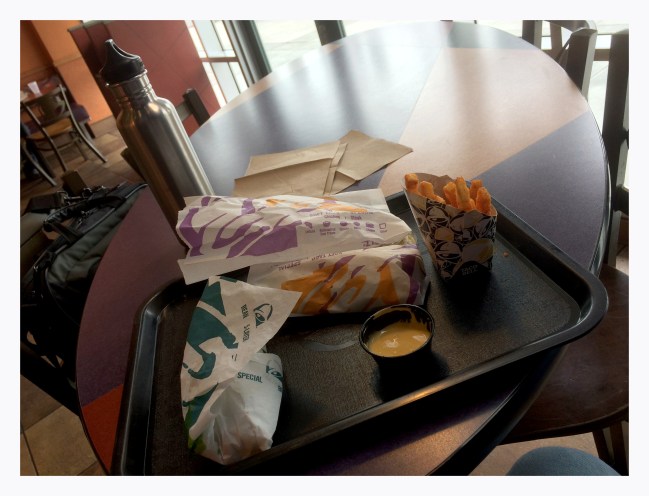
When we were in the car I asked him where we were going. “You’ll see,” he said. “I’m going to show you a little trick.” Five minutes later we pulled into the drive-thru at the Taco Bell on Ventura Boulevard in Sherman Oaks. “This place has a ton of vegetarian options,” he told me proudly, “and their dollar menu is great.” I looked over the options and eventually ordered a 7-layer Burrito, at Blake’s urging a Spicy Potato Soft Taco with easy sauce, and their limited-time Nacho Fries with Cheese Dip. It all came out to less than six dollars.
As we pulled away from the drive-through window with our food, Blake glanced at me and said, “You know, that 7-layer Burrito you got was $3.29? That’s how they get you. There’s a Cheesy Rice & Bean Burrito on the dollar menu for two dollars less.”
“Really?” I said coolly. At the moment I wasn’t about to concede anything, but on the numbers alone Blake had a point. I still had to conduct my own taste test, to see if consuming what I’d ordered came with any of the ill consequences I remembered from college. To my surprise, it didn’t. Maybe copious amounts of beer and tequila, when mixed with Taco Bell’s cuisine in the gut of a naive twenty year-old, produced some manner of toxic concoction. Who knows? Yet in the end Blake was right, and Taco Bell became my go-to place for a quick meal for the entirety of my trip. And that afternoon, after only a very light breakfast, I headed there for some lunch − and to get some work done − while waiting to see if by some miracle my dream of a tour at Pixar would come through. Close to ninety minutes later I found my last hope dashed with a text message. The person who was probably my best chance that morning was out of the office, which meant I finally had to concede defeat.
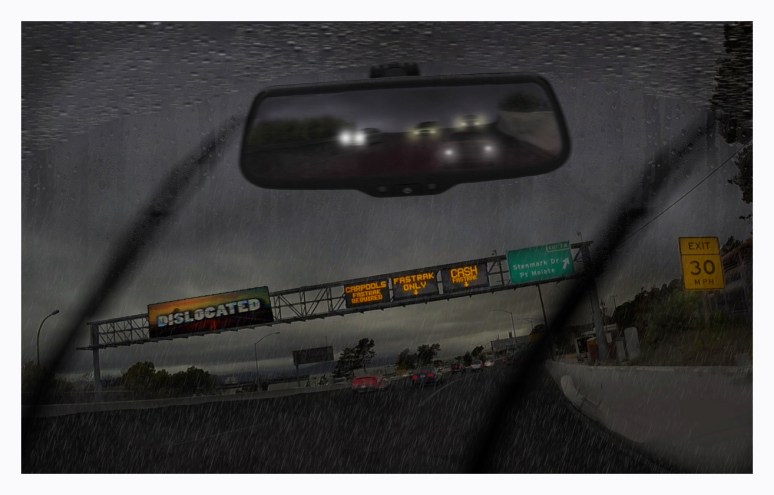
Disappointed, I packed up my laptop and got back on the road, completely forgetting to pop into the Pak ‘N Save Foods that was just across the street, or the Wells Fargo ATM that was less than two miles away. Instinct, or dispirited confusion, had taken over entirely, and I found myself headed for my hotel in Rohnert Park along Interstate 580 West instead. Not long after, as I approached the Richmond Bridge − or more specifically the Richmond Toll Plaza − I instantaneously slipped into a full-blown panic, greeted by a handful of electronic signs that hung above each of the toll booths, a number of them reading “Cash/Fastrak” – neither of which I had. In my haze I had failed to comprehend all the warnings leading up to that point, including the one for the last exit, and now I was faced with my toll collector – a dour, humorless, and entirely hardened Asian woman who greeting me with the coldest delivery of “five dollars” I have ever heard in my life.
“I’m sorry but I don’t have any cash. Do you take credit cards?” I asked her pathetically.
“No credit card! Only cash!” she reiterated harshly.
“But I don’t have any cash. What do I do?”
“Only cash!” she scolded me.
“If you don’t take credit cards, I don’t know what to do,” I pleaded. “I only have two dollars in my wallet.”
“No credit card! Only cash,” she snapped at me again. I began to wonder if we might be caught in this absurd loop for all of eternity.
“And what if I don’t have any cash?” I asked her. I could feel the impatience welling up inside me, but on the other hand I felt like a child, or at least a sorry excuse for an adult. She paused, and I was hopeful she was finally getting it.
“No enough cash?” she asked in a reasonable tone, and for a nanosecond I thought I sensed some inkling of her humanity. But as I nodded and said “Yeah” she quite literally looked down on me, while judgmentally shaking her head, and in one swift move handed me a bright goldenrod buck slip-sized notice with “Toll Violation” written across the top. “Call number,” she barked at me.
“Thank you,” I said, and drove away, very thankful for the somewhat quick escape.
After crossing San Francisco Bay, I continued north on the 580, and met up with the 101 Freeway near San Rafael. As I grew closer to the Lucas Valley Road exit, I realized I was about to head into the unknown for the first time since I’d left Los Angeles. Lucas Valley Road is the off-ramp I would always take whenever I’d visit Skywalker Ranch for work, and it was also the furthest north I’d ever travelled on the west coast. (Coincidentally, the valley is not named for George Lucas, but rather a rancher by the name of John Lucas − the nephew of one Timothy Murphy, who originally purchased 80 acres of what became known as Lucas Valley in 1846.) So along with my fond memories of “The Ranch” − staying in rooms named after famous filmmakers, entertainers, and painters; eating lunch next to Lake Ewok; getting to poke around the “Main House” and see memorabilia from some of my favorite movies – I was once again overcome with emotion. As the 101 Freeway shrank from four lanes to two, causing the traffic to snarl each time it did, I couldn’t help but be reminded of all the hopes I once had for this moment. It was supposed to be with her. We always talked about visiting Napa and Sonoma for the first time together – drinking in the stunning landscapes and beautiful wine. Our love of Sideways led us to find the Japanese remake on Amazon, and as we watched it’s familiar story play out with different actors, this time in Napa instead of the Santa Ynez Valley, we started talking about visiting ourselves, and then heading as far up the coast as time would allow. The conversation itself was so much fun I don’t think we ever finished the movie. Yet there I was, alone on a journey we had always talked about taking together. It was a bitter pill to swallow, and a momentary flashback to all the emotions I had experienced in the days before. I allowed myself to get lost in it all − but only until I reached the Good Nite Inn. After that I swore that I would let everything go. That I would forget about her, and enjoy two glorious days in some of the most beautiful wine country in the world, without any variety of misplaced nostalgia. That nothing would get in the way of my present, and some good wine.
Man, I had no idea.
 Dislocated